
Moving to Nepal with a cat in 2026 requires careful planning and adherence to specific import regulations set by the Government of Nepal. While Nepal is generally considered a pet-friendly destination, the process involves several mandatory steps, including securing an import permit and ensuring all vaccinations are up-to-date. This comprehensive guide will walk you through every detail, from microchipping to arrival procedures, ensuring a smooth and stress-free relocation for you and your feline companion. For a complete overview, see our full Nepal cat import guide.
Nepal — At a Glance
Nepal — At a Glance
| Difficulty | Moderate |
| Quarantine | Conditional (up to 7 days if documents are incomplete or health is questionable) |
| Microchip | ISO 15-digit required |
| Rabies Vaccine | Required |
| Import Permit | Yes |
| Typical Cost | £1,500–£4,000 / $1,900–$5,000 (excluding airfare) |
| Processing Time | 8–12 weeks |
Step-by-Step Cat Import Requirements for Nepal

Navigating the requirements for bringing your cat to Nepal can seem daunting, but by following a clear step-by-step process, you can ensure all regulations are met. This detailed timeline will guide you through each crucial stage, from initial preparations to your cat's arrival in Nepal.
Step 1: Microchip Implantation (Minimum 16 weeks before travel)
Your cat must be identified with an ISO-compliant 15-digit microchip before any vaccinations are administered. This is the foundational step for all international pet travel. Ensure the microchip is readable and registered to your current contact details. If your cat already has a microchip that is not ISO-compliant, you may need to have a second, compliant microchip implanted, or carry your own microchip reader.
Step 2: Rabies Vaccination (Minimum 21 days before travel)
After microchipping, your cat must receive a valid rabies vaccination. The vaccine must be an inactivated or recombinant vaccine approved by the World Organisation for Animal Health (WOAH, formerly OIE). For a primary vaccination, there is a mandatory waiting period of 21 days before travel. If your cat is receiving a booster, ensure it is administered before the previous vaccination expires, and no waiting period is required if done within the validity period.
Step 3: Other Core Vaccinations (Minimum 14 days before travel)
Beyond rabies, Nepal requires cats to be vaccinated against Feline Panleukopenia (FPV), Feline Viral Rhinotracheitis (FHV-1), and Feline Calicivirus (FCV). These core vaccinations should be administered at least 14 days prior to your planned departure date. Your vet should record the vaccine type, date, and expiry in your cat's health records.
Step 4: Obtain an Import Permit (1-2 months before travel)
An import permit is mandatory for all cats entering Nepal. This permit must be obtained from the Department of Livestock Services (DLS), under the Ministry of Agriculture and Livestock Development, Government of Nepal. You or your chosen pet relocation company must apply for this permit well in advance, typically 1-2 months before your travel date. The application requires details of your cat, vaccination records, and your travel itinerary. The permit is usually valid for 30 days from the date of issue.
Pro Tip
When applying for the import permit, clearly state your arrival airport (Tribhuvan International Airport, Kathmandu). This ensures the permit is correctly issued for the designated entry point and avoids potential delays upon arrival.
Step 5: Internal and External Parasite Treatment (Within 48 hours of travel)
Your cat must receive treatment for internal parasites (e.g., deworming for nematodes and cestodes) and external parasites (e.g., fleas and ticks) within 48 hours of your scheduled departure. This treatment must be administered by a licensed vet and recorded in the health certificate, including the product name, dosage, and date of administration.
Step 6: Official Health Certificate Issuance (Within 10 days of travel)
A government-endorsed health certificate is a critical document. This certificate must be issued by a government-approved vet in your country of origin within 10 days of your cat's departure. It must confirm your cat is healthy, free from infectious diseases, and fit for travel, detailing all microchip, vaccination, and parasite treatment information. The certificate must be endorsed by the official veterinary authority of your departure country.
Step 7: Travel Arrangements and Crate Preparation
Book your cat's flight well in advance, ensuring the airline is approved for live animal transport and understands Nepal's import regulations. Your cat must travel in an IATA-compliant travel crate that is appropriately sized, well-ventilated, and clearly labelled with your contact information. Familiarise your cat with the crate in the weeks leading up to travel to reduce stress.
Step 8: Arrival in Nepal and Customs Clearance
Upon arrival at Tribhuvan International Airport (TIA) in Kathmandu, your cat will undergo a veterinary inspection by officials from the Department of Livestock Services. You must present all original documents: the import permit, health certificate, and vaccination records. If all documents are in order and your cat appears healthy, it will be cleared for entry. Any discrepancies or health concerns may lead to further examination or, in rare cases, conditional quarantine.
Microchip & Vaccination Requirements for Nepal Cat Import
Understanding the precise microchip and vaccination protocols is paramount for a successful cat import to Nepal. These are non-negotiable requirements that form the backbone of Nepal's biosecurity measures.
Microchip Requirements
Every cat entering Nepal must be identified with an ISO-compliant 15-digit microchip. This microchip must be implanted *before* any rabies vaccination. The date of microchip implantation must precede the date of the rabies vaccination. If your cat has an older, non-ISO microchip, it is strongly recommended to implant a new ISO-compliant one. Alternatively, you must provide your own microchip scanner at the point of entry, which can cause significant delays and is generally not advised.
Good to Know
The ISO 11784/11785 standard ensures that microchips can be read by universal scanners, which is crucial for international travel. Always verify with your vet that the microchip meets this standard.
Rabies Vaccination
A valid rabies vaccination is mandatory. The vaccine must be administered by a licensed vet after the microchip has been implanted. For a primary vaccination, there is a waiting period of 21 days from the date of vaccination before your cat is eligible to travel. Booster vaccinations must be given within the validity period of the previous vaccine to avoid the 21-day waiting period. The vaccination record must clearly state the vaccine name, manufacturer, batch number, date of administration, and validity period.
Other Core Vaccinations
In addition to rabies, Nepal requires cats to be vaccinated against common feline diseases. These include:
- Feline Panleukopenia (FPV)
- Feline Viral Rhinotracheitis (FHV-1)
- Feline Calicivirus (FCV)
These vaccinations should be current and administered at least 14 days before your cat's scheduled arrival in Nepal. Ensure your vet records these vaccinations accurately in your cat's health book, including the date of administration and the next due date.
Warning
Failure to adhere to the microchip-first rule for rabies vaccination will invalidate the rabies vaccine for import purposes, potentially leading to significant delays, re-vaccination, or even quarantine upon arrival in Nepal.
Import Permit & Health Certificate for Moving to Nepal with a Cat
These two documents are the cornerstones of your cat's legal entry into Nepal. Without them, entry will be denied. Understanding their specific requirements and application processes is crucial for anyone planning to bring a cat to Nepal.
The Nepal Cat Import Permit
An import permit issued by the Department of Livestock Services (DLS) of Nepal is mandatory. This permit serves as official permission for your cat to enter the country. It must be applied for and secured before your cat travels. The application typically requires:
- A copy of your cat's microchip certificate.
- Proof of current rabies vaccination.
- Details of your travel itinerary (arrival date, flight number).
- Your contact information in Nepal.
- A completed application form (Form No. 1, 'Application for Import of Live Animals').
The permit is usually valid for 30 days from its date of issue. It is advisable to apply 1-2 months in advance to allow for processing time. The DLS website (www.dls.gov.np) provides forms and contact details, though navigating it can be challenging for non-Nepali speakers. The cost for the import permit is NPR 1,000 (approximately $7.50 USD).
Pro Tip
If you are using a pet relocation company, they will handle the entire import permit application process on your behalf, significantly simplifying this administrative step. This is often the most efficient way to secure the permit.
The Official Health Certificate
The health certificate is a document issued by a licensed vet in your country of origin and then endorsed by your country's official government veterinary authority (e.g., APHA in the UK, USDA in the USA). It must be issued within 10 days of your cat's departure for Nepal. This certificate must confirm:
- Your cat's microchip number and implantation date.
- Details of all vaccinations (rabies, FPV, FHV-1, FCV), including dates, vaccine names, and validity periods.
- Dates and products used for internal and external parasite treatments (within 48 hours of travel).
- A statement that your cat shows no clinical signs of infectious or contagious diseases and is fit for travel.
- Your name and address, and your cat's breed, sex, and age.
The official endorsement from your government's veterinary body is crucial. Without this, the health certificate will not be accepted by Nepali authorities. This endorsement typically involves a fee and can take a few days to process, so factor this into your timeline.
Warning
The health certificate's validity period (10 days) is strict. If your cat's flight is delayed beyond this window, you may need to obtain a new certificate, incurring additional vet and endorsement fees and potentially delaying travel.
Cat Quarantine Rules in Nepal
One of the most common concerns for pet owners is the possibility of quarantine. Fortunately, Nepal does not impose a mandatory, routine quarantine period for cats that meet all import requirements. However, there are specific circumstances under which your cat may be subject to a conditional quarantine.
Good News
If all your documentation is complete, accurate, and your cat appears healthy upon arrival, it will typically be released to you immediately after the veterinary inspection at Tribhuvan International Airport.
Conditional Quarantine Scenarios
Quarantine in Nepal is applied on a case-by-case basis, primarily when there are concerns about the cat's health or the validity of its import documentation. These scenarios include:
- Incomplete or Incorrect Documentation: If your import permit is missing, expired, or if the health certificate contains errors, omissions, or lacks proper government endorsement, your cat may be held.
- Signs of Illness: If your cat shows any clinical signs of infectious or contagious diseases upon arrival, the DLS veterinary officer has the authority to mandate quarantine for further observation and testing.
- Missing Vaccinations or Treatments: If any required vaccinations (rabies, FPV, FHV-1, FCV) are missing or not current, or if parasite treatments were not administered or documented correctly, quarantine may be imposed until these issues are rectified.
- Unreadable Microchip: If the microchip cannot be read by the DLS scanner, or if it is not ISO-compliant and you haven't provided a reader, this can lead to delays and potential quarantine.
Quarantine Duration and Location
The duration of conditional quarantine can range from a few days to a maximum of 7 days, depending on the nature of the issue. During this period, your cat will be housed at a designated facility managed by the Department of Livestock Services, typically located near Kathmandu. You will be responsible for any associated costs, including housing, feeding, and any necessary veterinary examinations or treatments.
Warning
To avoid quarantine, meticulously double-check every document, vaccination date, and treatment record. Any oversight can lead to significant stress for your cat and unexpected costs for you.
Approved Entry Points for Cats in Nepal
For international cat imports, Nepal designates specific entry points where veterinary inspections can be carried out by the Department of Livestock Services. This ensures proper biosecurity and adherence to import regulations.
Tribhuvan International Airport (TIA), Kathmandu
The primary and virtually exclusive approved entry point for cats arriving by air in Nepal is Tribhuvan International Airport (KTM) in Kathmandu. All international flights carrying live animals will be directed here for customs and veterinary clearance. The DLS maintains a veterinary inspection post at the airport to process incoming pets.
Good to Know
While Nepal has several land border crossings, these are generally not equipped or approved for the import of live animals under international regulations. Attempting to bring a cat across a land border without prior, specific approval from DLS is highly discouraged and will likely result in refusal of entry.
Customs and Veterinary Inspection at TIA
Upon arrival at TIA, your cat will be processed through the cargo terminal if travelling as manifest cargo, or collected from the baggage claim area if travelling as excess baggage (though this is less common for international moves). You will then proceed to the DLS veterinary inspection office. Here, officials will review all original documents, including your import permit, health certificate, and vaccination records. They will also conduct a physical examination of your cat to ensure it is healthy and matches the descriptions in the paperwork.
Ensure you have all documents readily accessible and organised to facilitate a swift inspection. Any customs duties or fees for pet import, though generally minimal for personal pets, will also be handled at this stage.
Warning
Do not attempt to enter Nepal with your cat through any port other than Tribhuvan International Airport. Unauthorised entry points lack the necessary veterinary infrastructure and personnel, leading to immediate refusal of entry and potential legal complications.
Cost Breakdown: Moving Your Cat to Nepal
The cost of moving your cat to Nepal can vary significantly based on your origin country, whether you use a pet relocation company, and the specific airline. Here's a detailed breakdown of typical expenses you can expect.
Cost Breakdown
| Item | Cost (local) | Cost (USD) |
|---|---|---|
| ISO Microchip Implantation | £20–£50 / $25–$65 | $25–$65 |
| Rabies Vaccination | £30–£60 / $40–$80 | $40–$80 |
| Core Vaccinations (FPV, FHV-1, FCV) | £40–£80 / $50–$100 | $50–$100 |
| Parasite Treatment (internal & external) | £20–£40 / $25–$50 | $25–$50 |
| Official Health Certificate (vet fee) | £80–£150 / $100–$200 | $100–$200 |
| Government Endorsement (e.g., APHA/USDA) | £50–£200 / $65–$250 | $65–$250 |
| Nepal Import Permit Fee | NPR 1,000 | $7.50 |
| IATA-Compliant Travel Crate | £80–£250 / $100–$320 | $100–$320 |
| Airline Cargo Fees (depending on route/size) | £500–£2,000 / $600–$2,500 | $600–$2,500 |
| Pet Relocation Company Services (optional) | £1,000–£3,000 / $1,250–$3,800 | $1,250–$3,800 |
| Contingency/Quarantine (if applicable) | £100–£500 / $125–$650 | $125–$650 |
The total estimated cost for moving your cat to Nepal, excluding airfare, typically ranges from £1,500 to £4,000 (approximately $1,900 to $5,000 USD) if you manage most of the process yourself. If you opt for a full-service pet relocation company, the total cost, including their fees and all other services, can range from £3,000 to £6,000 (approximately $3,800 to $7,500 USD), depending on the complexity of the move and the services included.
Pro Tip
Always get multiple quotes for airline cargo and pet relocation services. Prices can vary significantly, and comparing options can help you find the most cost-effective solution without compromising on your cat's safety and comfort.
Document Checklist for Nepal Cat Import
Having all your documents organised and readily accessible is crucial for a smooth entry into Nepal. Use this checklist to ensure you haven't missed anything.
📋 Document Checklist
- ☐Original ISO-Compliant 15-Digit Microchip Certificate/Record
- ☐Original Rabies Vaccination Certificate (showing date, vaccine name, validity, and microchip number)
- ☐Original Core Vaccination Certificates (FPV, FHV-1, FCV with dates and validity)
- ☐Original Official Health Certificate (issued by licensed vet within 10 days of travel)
- ☐Original Government Endorsement of Health Certificate (from your country's official veterinary authority)
- ☐Original Nepal Import Permit (issued by Department of Livestock Services)
- ☐Proof of Internal and External Parasite Treatment (recorded on health certificate or separate vet statement)
- ☐Copy of your Passport/ID
- ☐Airline Air Waybill (for cargo shipments)
- ☐Contact details for your local vet and your contact in Nepal
It is highly recommended to carry both original documents and several photocopies. Keep all documents in a waterproof folder and have them easily accessible upon arrival at Tribhuvan International Airport.
Choosing a Pet Relocation Company for Nepal
While it is possible to manage the process of moving to Nepal with a cat independently, the complexities of international pet travel, especially with varying regulations and language barriers, often make a professional pet relocation company an invaluable asset. These companies specialise in navigating the intricate requirements, ensuring a smooth and stress-free journey for your feline friend.
Benefits of Using a Pet Relocation Company
A reputable pet relocation company offers a range of services that can significantly ease the burden of international travel:
- Expert Knowledge: They are up-to-date with the latest Nepal cat import requirements 2026, including specific forms, timelines, and veterinary protocols.
- Document Management: They handle all paperwork, including obtaining the Nepal import permit, coordinating with vets for health certificates, and ensuring government endorsements.
- Logistics & Travel: They arrange IATA-compliant crates, book flights with pet-friendly airlines, and manage airport transfers and customs clearance in both origin and destination countries.
- Stress Reduction: By managing the intricate details, they reduce stress for both you and your cat, allowing you to focus on your own relocation.
- Contingency Planning: In case of unexpected delays or issues, they have the experience and resources to adapt and resolve problems efficiently.
What to Look for in a Company
When selecting a pet relocation company, consider the following:
- Experience with Nepal: Choose a company with proven experience specifically in pet imports to Nepal.
- Accreditation: Look for companies accredited by reputable industry bodies like IPATA (International Pet and Animal Transportation Association).
- Transparency: Ensure they provide a clear, itemised quote with no hidden fees.
- Communication: They should offer regular updates and be responsive to your queries.
- Veterinary Partnerships: Companies with established relationships with vets can streamline the health certificate process.
Recommended Partner
Get Expert Help Moving to Nepal
Starwood Animal Transport specialises in cat relocations to Nepal and handles all paperwork, permits and logistics.
Get a Free Quote from Starwood →While the cost of a pet relocation company is an additional expense, the peace of mind and assurance that your cat's journey is handled professionally and compliantly is often well worth the investment, especially when moving to Nepal with a cat.
Common Mistakes to Avoid When Moving to Nepal with a Cat
Even with meticulous planning, small errors can lead to significant delays or complications when bringing your cat to Nepal. Being aware of common pitfalls can help you avoid them.
Warning
Incorrect Rabies Vaccination Order: Administering the rabies vaccine *before* the microchip is implanted is a critical error. Nepal, like many countries, requires the microchip to be in place first. If the vaccine precedes the microchip, it will be considered invalid, and your cat will need to be re-vaccinated and observe another 21-day waiting period, delaying your travel significantly.
Warning
Missing Government Endorsement: A health certificate signed only by your local vet is insufficient. It *must* be endorsed by the official government veterinary authority of your departure country (e.g., APHA, USDA). Without this official stamp, the document is invalid for Nepal pet import, leading to potential quarantine or refusal of entry.
Warning
Expired or Incorrect Import Permit: The Nepal import permit has a strict validity period, typically 30 days. Ensure your cat arrives within this window. Additionally, verify that the permit correctly states your cat's details and the designated entry airport (Tribhuvan International Airport, Kathmandu). An expired or incorrect permit will cause immediate issues at customs.
Other common mistakes include:
- Not booking flights early: Cargo space for pets is limited, especially on popular routes.
- Using a non-IATA compliant crate: Airlines will refuse to transport pets in crates that do not meet IATA standards for size, ventilation, and construction.
- Forgetting to acclimatise your cat to the crate: This can lead to significant stress during travel.
- Not carrying original documents: Only original, physical documents will be accepted by Nepali authorities upon arrival. Digital copies are not sufficient.
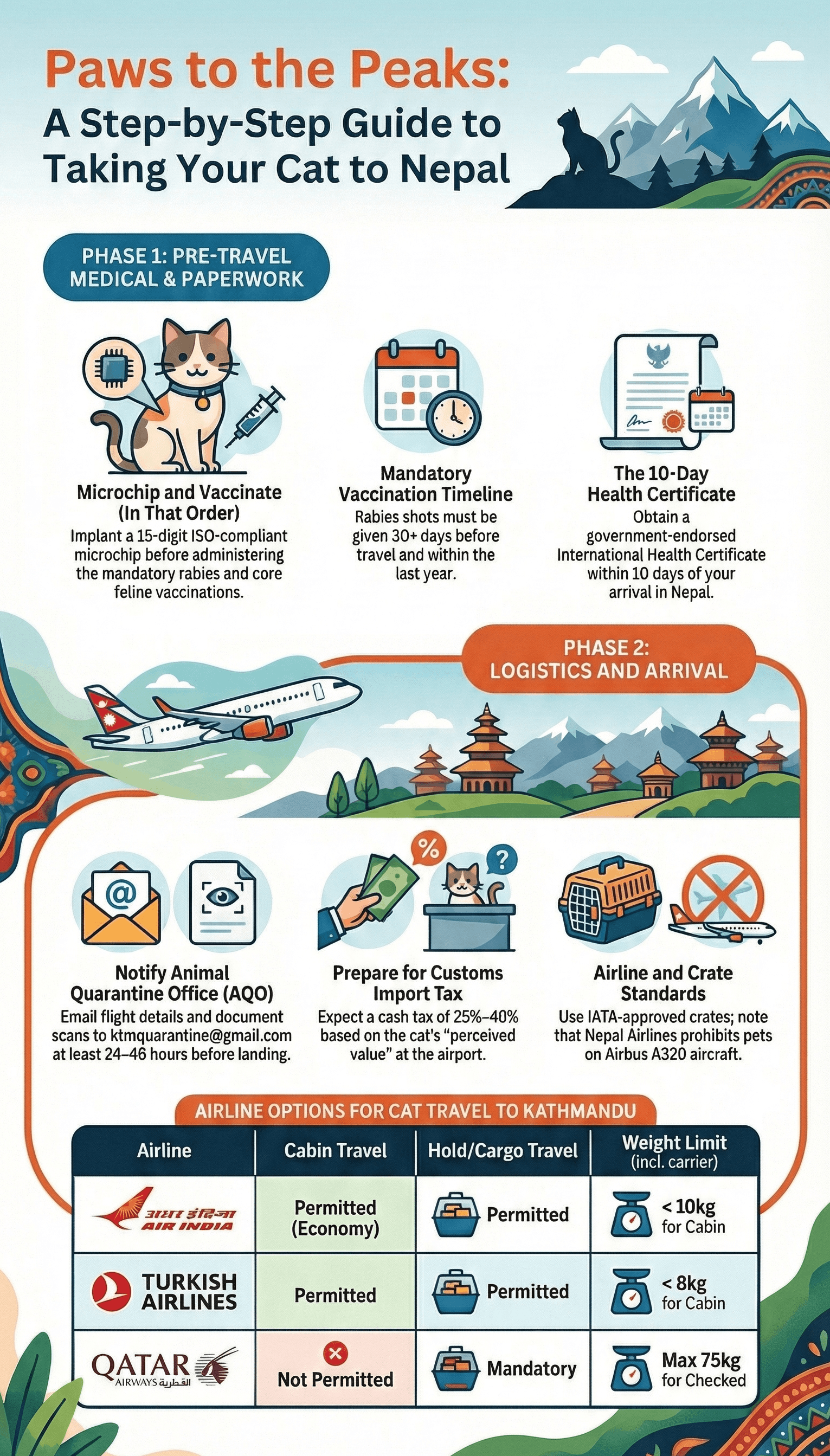
At a Glance: Nepal Cat Import Requirements
Frequently Asked Questions
Do cats need quarantine in Nepal?
No, cats do not require mandatory routine quarantine in Nepal if all import requirements are met. However, conditional quarantine for up to 7 days may be imposed if documents are incomplete, incorrect, or if the cat shows signs of illness upon arrival at Tribhuvan International Airport.
What are the Nepal pet import requirements 2026 for cats?
For 2026, Nepal requires cats to have an ISO-compliant 15-digit microchip, current rabies vaccination (at least 21 days prior to travel), and core vaccinations (FPV, FHV-1, FCV at least 14 days prior). An import permit from the Department of Livestock Services and a government-endorsed health certificate issued within 10 days of travel are also mandatory.
How much does it cost to bring a cat to Nepal?
The cost to bring a cat to Nepal varies, but typically ranges from £1,500–£4,000 ($1,900–$5,000 USD) if managed independently (excluding airfare). Using a full-service pet relocation company can bring the total to £3,000–£6,000 ($3,800–$7,500 USD), covering all veterinary, permit, crate, and logistics fees.
Can I bring my cat to Nepal without a rabies vaccine?
No, it is strictly prohibited to bring a cat to Nepal without a valid rabies vaccination. The vaccine must be administered after microchip implantation, and a 21-day waiting period is required for primary vaccinations before your cat is eligible to travel.
How long does it take to process Nepal cat import documents?
The entire process for Nepal cat import, from microchipping to final document endorsement, typically takes 8–12 weeks. The import permit itself usually takes 1-2 months to obtain, and the health certificate must be issued within 10 days of departure.
Where do I get a Nepal import permit for my cat?
The Nepal import permit for your cat must be obtained from the Department of Livestock Services (DLS) under the Ministry of Agriculture and Livestock Development, Government of Nepal. You can apply directly or have a pet relocation company handle the application on your behalf, providing all necessary pet and travel details.
 Thailand
 Singapore
 United Arab Emirates
 Qatar
Qatar India
India Sri Lanka